
The Chilean film “The Mysterious Gaze of the Flamingo“ directed by Diego Céspedes, has quickly become a standout in contemporary world cinema, primarily for securing the prestigious Un Certain Regard Prize at the Cannes Film Festival. Further cementing its importance, the film was chosen as Chile’s official submission for Best International Feature Film at the Academy Awards, representing the country in the race for the 98th Oscars.
A queer bar in the middle of the desert, in a mining town during the 1980s: this is the powerful premise of The Mysterious Gaze of the Flamingo, a film that not only captures attention through its story, but also offers beautiful cinematography.
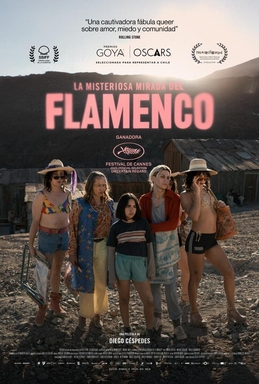
Flamenco is a trans woman who lives with her daughter in a bar where only trans women live. This place works as a refuge. The bar is often visited by miners who work in the desert. However, there is a myth created by ignorance: people say that “you should not look at faggots in the eyes, because they can infect you.” In such an isolated town, and in a time when people did not know much about sexually transmitted diseases, this myth becomes almost symbolic.Throughout the film, we see miners covering their eyes when they pass by these women. This action is not only about fear, but also about denial. It shows how people choose not to see reality, not to see others as human beings. The film uses this idea to show how ignorance can become a form of silent violence.
Visually, the film is very beautiful. The wide shots of the desert show how isolated the town is. At the same time, there is a strong contrast: the outside world looks dry, old, and dusty, while inside the bar it feels more colorful and warm, even with very few resources. This contrast highlights the sense of community.The character design is also very strong. The film shows queer people in a realistic way: they are poor, excluded, and living without luxury. They are not trying to look glamorous, they are trying to survive. Still, the film does not focus on hate. The characters do not live with strong resentment; instead, they try to exist in peace, even in a difficult world. The bar becomes a chosen family, different but united.The miners also have some development. Some of them start with rejection but slowly change their perspective. Others show contradiction: they are afraid of these women, but they still go to the bar. These moments can feel a bit absurd, but they also work as a subtle satire of social hypocrisy.
The actors in the film are members of the queer community, and they express themselves using the slang and language commonly used within that community in everyday life. Chilean films often tend to adopt a more neutral form of Spanish when aiming for international audiences; however, that is not the case here. The characters continue to speak in a distinctly Chilean and queer way, using highly localized slang.
This choice works perfectly for both audiences: Chilean viewers can feel the film’s authenticity through its familiar language and expressions, while the Chilean queer community can see themselves genuinely represented on screen. At the same time, even viewers who are neither Chilean nor part of the community can still appreciate the portrayal of queer culture and the prejudices people had to endure during that time, especially in a sexist and homophobic town in the middle of the desert in the 1980s in Latin America.
In the end, The Mysterious Gaze of the Flamingo is not only a story about marginalization. It is also about the act of seeing: what it means to see, and who we choose not to see. It is an uncomfortable film, but that is exactly why it feels important. You can watch the trailer here. And also you can currently rent or buy the movie on Prime Video.