



What has been happening over the past several months is heartbreaking. Across communities, families are being separated, parents are being detained, children are afraid to go to school, parents fear for their children’s safety and wellbeing, and families are living with uncertainty. Regardless of one’s political perspective, the human toll is real.
If you are affected by this, it is ok to feel angry. It is okay to feel scared. It is okay to feel overwhelmed. Your emotions are valid.
For many in the Hispanic community, recent immigration enforcement efforts have created a climate of fear that follows people into their workplaces, homes and everyday lives. How do you remain focused on your goals when uncertainty is part of your daily life?
I spoke with two field workers who asked to remain anonymous. One shared:
“El tiempo esta difícil ahorita. Nosotros venimos a trabajar para nuestra familia. Antes el dicho era ‘El Sueño Americano.’ Ahora despertamos y no sabemos si vamos a regresar a casa ese día, por tener el miedo de que nos vayan a regresar , aunque tengamos el derecho de estar aquí legalmente.”
“Times are difficult right now. We came here to work for our families. It used to be called ‘The American Dream’ Now we wake up not knowing if we will return home that day because we are afraid of being sent back, even though we have the legal right to be here.”
Another explained:
“Uno nos ensena a no mostrar nuestras emociones, y aunque tengamos miedo o estemos enojados, tenemos que seguir echándole ganas al trabajo. Para eso estamos aquí: para trabajar y chingarle todos los días, aunque tengamos miedo. Amino para la raza.”
“We are taught not to show our emotions, and even if we are afraid or angry, we have to keep pushing ourselves at work. That’s why we are here, to work hard every day, even when we are scared. Stay strong my people.”
Both emphasized resilience, but resilience does not erase fear.
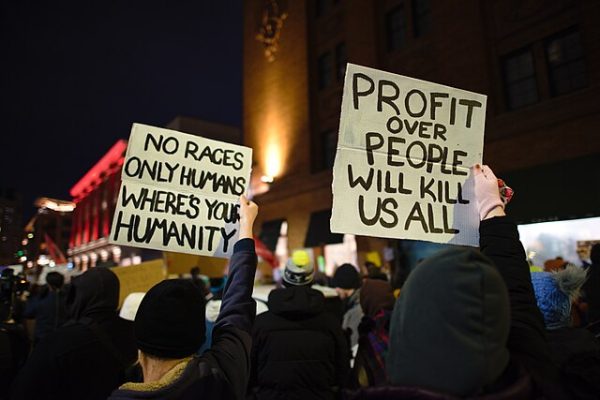
Protest against ICE in Minneapolis 9 January 2026, picture from Wikimedia commons
When I discussed this issue with my parents, they reassured me that because I was born in the United States, I have legal protections they did not. Yet I still feel the weight of uncertainty. Being a U.S. citizen doesn’t change my skin color, my last name, or how I might be perceived during heightened enforcement. Identity cannot be separated form lived experience.
While most enforcement interactions do not result in violence, there have been recent widely reported incidents involving U.S. citizens during federal immigration operations. These events, though rare, have intensified fear within affected communities.
Even when legal status offers protection on paper, emotional security is not guaranteed. For many students on campus, whether undocumented, from mixed status families, or children of immigrants, this issue is not abstract policy. It affects concentration in class, mental health, and a sense of belonging. Even those who are citizens may carry anxiety through family and community connections.
Although the workers I interviewed did not openly discuss their mental health, the strain is evident. There is an expectation to remain strong, to keep working, and to suppress fear. But emotional impact does not disappear simply because is hidden.
This article is not about politics; it is about people. It is about acknowledging that behind every headline are families navigating uncertainty, resilience, and hope at the same time.
To those who feel unseen: we see you.
To those who feel unheard: Your stories matter
And to our campus community: Empathy is not partisan, it is human.
Para la comunidad: Los vemos, Estamos aquí por ustedes y no nos vamos a rendir.
To the community, We see you, We stand with you, and we will not give up.




Ana Madera • Feb 25, 2026 at 6:01 pm
Very well said! I applaud you for being the voice of those who can’t!